What is a tuck-in acquisition?
A tuck-in acquisition is a larger company buying a smaller one and absorbing it completely into an existing division or business unit. The target's brand, systems and structure usually disappear, and what remains shows up inside the acquirer as extra capability, product or people.
Its close relative is the bolt-on. The two terms are often used interchangeably, but a bolt-on usually keeps some identity and carries on as its own unit, where a tuck-in is folded in completely. Facebook's purchase of Instagram is sometimes described as a tuck-in, but it's the textbook bolt-on: Instagram kept its own brand and app, which is why DealRoom uses it as its example of one. Private equity adds to the confusion by calling almost any add-on to a platform company a bolt-on.
In technology, a typical tuck-in is small: a team and a product, often before it has scaled, bought for what it can do inside the buyer rather than for its own revenue. Within that, I find it useful to separate two kinds, because the difference matters later on.
- Capability tuck-ins buy technology, IP or an engineering team to fill a gap in the roadmap.
- Customer tuck-ins buy a customer base, revenue or a foothold in a niche market.
Plenty of deals are a mix of both, but most have a main reason, and the main reason decides a lot about how the deal should be done.
Why serial acquirers rely on them
Small deals done often have a better track record than big ones done occasionally. McKinsey found that between 2007 and 2017 the "programmatic" acquirers, those making more than two small or midsize deals a year that together add up to a meaningful share of their market value, delivered higher excess shareholder returns than peers relying on large deals, occasional acquisitions or organic growth.
The reasons for doing those deals have shifted too. Bain found that 82% of technology M&A in 2019 were scope deals, done to add capabilities, IP or talent or to move into faster-growing segments, up from an even split with scale deals five years earlier. In technology, most deals are now about adding something new (right now, often with an "AI" tag) rather than just getting bigger.
Where tuck-ins go wrong
The appeal of a tuck-in is speed and lower risk than a large deal. The problems tend to show up in three places.
Price. Capability is scarce, and scarce things cost more. The same Bain report found that between 2015 and 2019, premiums on technology scope deals were 51% higher than on scale deals, while cost synergies were 42% lower. You pay more and save less.
Fit. You buy what exists, not what you would have specified. The product was built for a market, for other customers and on someone else's stack, and the integration work starts on the day the deal closes.
People. This is the one that hurts most in a capability tuck-in, because the team is often most of what you paid for. A 2025 study by Nikolaus Seitz and Erik Lehmann tracked 241 acquisitions by Meta and Google and found around 30% of founders had left within two years, nearly half by year four, and only 27% were still there after five.
Technology tuck-in vs Made-to-Order Startup
A Made-to-Order Startup is a capability acquisition with the steps in a different order. We create and fully fund a "NewCo" to your specification, and you acquire it at a pre-agreed price only once agreed KPIs are met.
Taking the three problems in turn:
Price. The price is agreed before the build starts, and you only pay it if the KPIs are met. There's no auction against other buyers who spotted the same gap, and no scarcity premium on the day.
Fit. The specification is the starting point, so the architecture, the APIs and how it fits your environment are part of the brief, not a project you inherit at close. There's also nothing to unwind: the NewCo has no other customers, contracts or product commitments.
People. The team is recruited knowing who the buyer is, paid a market-rate salary, and holds equity that is fully vested before the sale. They arrive as a team, the technology they build is the thing you ordered, and they spend the build working alongside your people. Two of the conditions that study linked to founders staying, a team kept together and technology that gets used, are built into the model, though I'll be honest that we don't yet have our own data at that scale to prove the effect.
The trade-offs are real too. A build will usually take longer than buying something that already exists, so if a good target is on the market at a sensible price and you need it this quarter, buy it. And a Made-to-Order Startup has exactly one customer, you, so it can't hand you a customer base, revenue or market share.
Side by side, the three routes compare like this.
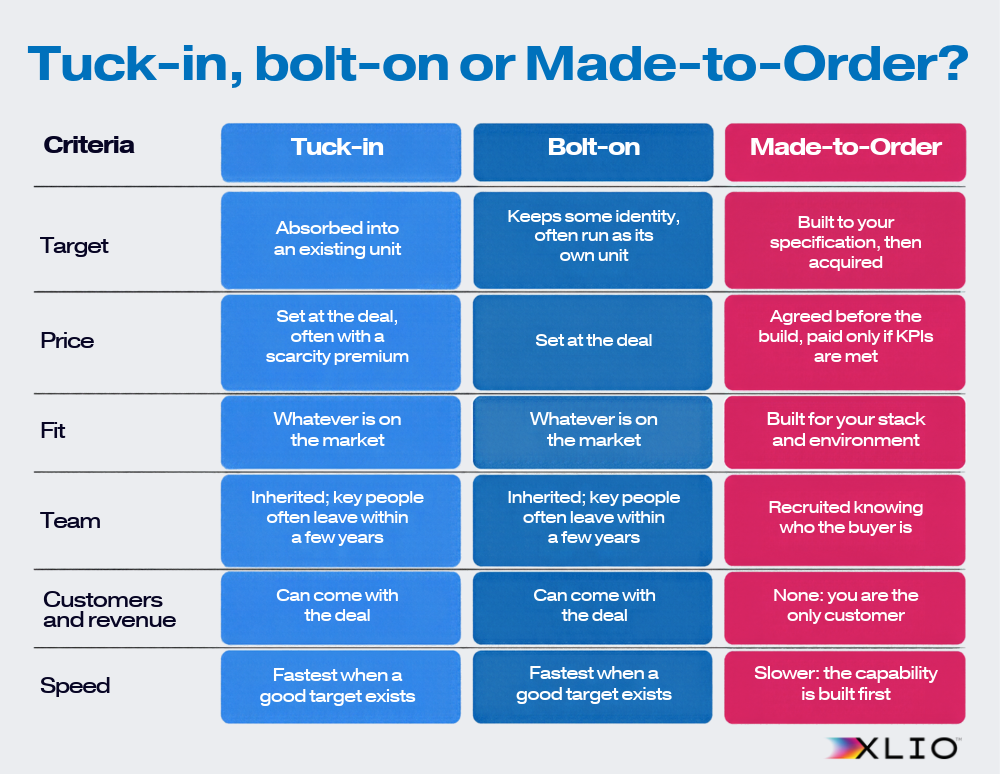
Some are, for sure. Capability tuck-ins share most of the traits where Made-to-Order is strongest: a defined gap, a need to own the result, targets that are scarce or expensive, and a deal whose value depends on the team staying. Customer tuck-ins not so much, because what you're buying is the one thing a NewCo built for a single buyer will never have.
If you're weighing up a tuck-in, these five questions will tell you which side of that line you're on.
- Are we buying a capability, or customers and revenue?
- Could we write down what it needs to do, and how we'd know it had been done?
- Is there a target on the market that fits, at a price that makes sense?
- Does the value of the deal depend on the team staying after close?
- Can we wait for a build, or do we need to close this quarter?
Tuck-in acquisitions: common questions
What's the difference between a tuck-in and a bolt-on acquisition?
The terms are often used interchangeably. Strictly, a tuck-in is absorbed completely into an existing business unit, while a bolt-on keeps some identity and may run as its own unit. Instagram, which kept its brand inside Facebook, is the usual example of a bolt-on.
Why are tuck-ins seen as low risk?
Each deal is small relative to the acquirer, so a mistake costs less, and a smaller, simpler business is easier to absorb. The risk doesn't disappear, though. It moves to execution, because the value depends on doing deals regularly and integrating each one well.
Can tuck-in acquisitions fail?
Yes. The usual causes are paying a premium for scarce capability, buying a product that doesn't fit your stack, and losing the team after close. In one 2025 study of founders acquired by Google and Meta, around 30% had left within two years.
What's the difference between a tuck-in and a roll-up?
A roll-up buys several small companies in a fragmented market, usually with private equity backing, and combines them into one larger business. A tuck-in is a single smaller company folded into a buyer that already exists.
Can you build a tuck-in instead of buying one?
For a capability tuck-in, yes. A Made-to-Order Startup builds the capability to your specification, and you acquire it at a pre-agreed price once agreed KPIs are met. For a customer tuck-in, no: a NewCo built for one buyer has no customers to bring with it.
If you're looking at a tuck-in and suspect you're about to pay a premium for the nearest match to what you need, our process page shows how a build runs from specification to acquisition, and you can get in touch to talk it through. We'll tell you straight whether ordering one makes more sense.
Sources: Corporate Finance Institute, Bolt-On Acquisitions, on tuck-in and bolt-on definitions; DealRoom, Bolt-on & Tuck-in Acquisition: The Ultimate Guide, on Instagram as a bolt-on; Divestopedia, Roll-Up, on roll-ups; Rudnicki, Siegel and West, How lots of small M&A deals add up to big value, McKinsey Quarterly (July 2019), on programmatic M&A; Bain & Company, Buying Boosts Building in Tech M&A (October 2020), on scope deals, premiums and synergies; Nikolaus Seitz and Erik E. Lehmann, Does acqui-hiring pay off? An empirical investigation of founder retention, Small Business Economics (published online November 2025), on founder retention; descriptions of XLIO's model from our own FAQ.