
Build it yourself
Building in-house keeps control where you want it: inside your own walls, on your own roadmap. But a specialised capability not already within your team, something like AI, cybersecurity, niche data science, say, competes for the same small pool of talent that every other company is chasing. Hiring takes months you don't have, the people you want are already employed, and every week spent recruiting is a week your competitor keeps shipping. The scarcity can also lead to compensation challenges as engineers look at alternate paths promising fat stock options and unicorn exits. Even once the team is in place, you're then paying for a full build cycle from a standing start, absorbing (or stealing from) your current engineering budget with no guarantee the result actually works.
Buy an existing company
Acquiring a company that already exists solves the speed problem, in theory. In practice, the target that's actually for sale rarely matches what you need. It's in the wrong country. It carries investors with their own return timelines and their own view of price. Its codebase leans on open-source dependencies you'd never have chosen yourself - or maybe a different architecture entirely from the one you’d choose for easy integration. And the moment a banker is running a process, you're in a competitive auction, bidding against buyers who may value the business for reasons that have nothing to do with your strategy.
The startup likely also comes with sales, marketing and HR overhead that either needs to be absorbed or let go - but must be paid for in the valuation, as must any acquired customers, whether or not they are valuable to your business moving forward.
Then there's the cap table. Every investor, every convertible note, every departed co-founder still holding equity is a party who has to sign off before the deal closes, or who can hold the whole thing up by not cooperating. Research on cap table due diligence puts the cost of unresolved ownership disputes at 0.5 to 1.5 times EBITDA in reduced price, sometimes enough to disqualify a target from a buyer's process altogether. None of that shows up in the pitch deck. It shows up three weeks before signing.
And if the company is living its best life burning a series of VC lead funding rounds, the VC’s desire to realise a 10x multiple on their investment is likely misaligned with the value that you place on that business.
Acqui-hire
An acqui-hire buys the team without the baggage of a full operating business, and it's often faster than a standard acquisition. But you're still negotiating with existing investors who have their own preferences on price and structure. The team you're acquiring was built for somebody else's roadmap, not yours, so the technology rarely lines up with your exact specification. And you're still doing full diligence on a business you didn't design, hoping the parts you actually want survive the integration.
Success rates on traditional M&As are worse than you might expect
- Harvard Business Review puts overall M&A failure rates as high as 70 to 90%. A 40,000-deal analysis spanning 40 years, reviewed by the CFA Institute, puts it at 70 to 75%, roughly twice the failure rate for comparable internal capital projects.
- Bain & Company found that 60% of deals failed to meet internal expectations back in 2004
- On shareholder returns, BCG found only 47% of deals produce a positive shareholder return within a year of closing. Not every deal carries the same odds though.
- Bolt-on acquisitions within an acquirer's own core industry succeed 80 to 85% of the time, per McKinsey data cited by M&A analysis firm Tiger Team.
- Experience compounds that advantage: the same Bain research found that frequent acquirers earned 57% higher shareholder returns than non-acquirers between 2000 and 2010, a gap that's since widened to roughly 130%.
Experience is doing most of the work, but most companies never get the reps.
The Fourth Way - Made to Order
Now there's a fourth option, and it starts from a different question: instead of finding a company that's close enough, what if you specified exactly what you needed and had it built to that spec?
That's what we at XLIO Ventures call a Made-to-Order Startup. You define the technology, the team and the timeline. Together, you and XLIO agree the KPIs that trigger the sale and the price you'll pay, before the company exists. XLIO then funds and builds it, carrying all the cost and risk of that build. You get visibility throughout - without writing a cheque until the KPIs are met. When they are, you acquire a company with only two owners - XLIO and the founding team, no investors to negotiate with, no encumbrances, no "surprise" cap table. The team was recruited knowing from day one who they were building for. There's no integration gap to close, because the technology and the people were built to fit your business from the start. And there's more goodness in this model when all you want is the technology. No bloated rounds of funding to recoup that have been spent on sales and marketing, no additional team members that must be found a new role or let go.
It's a win-win.
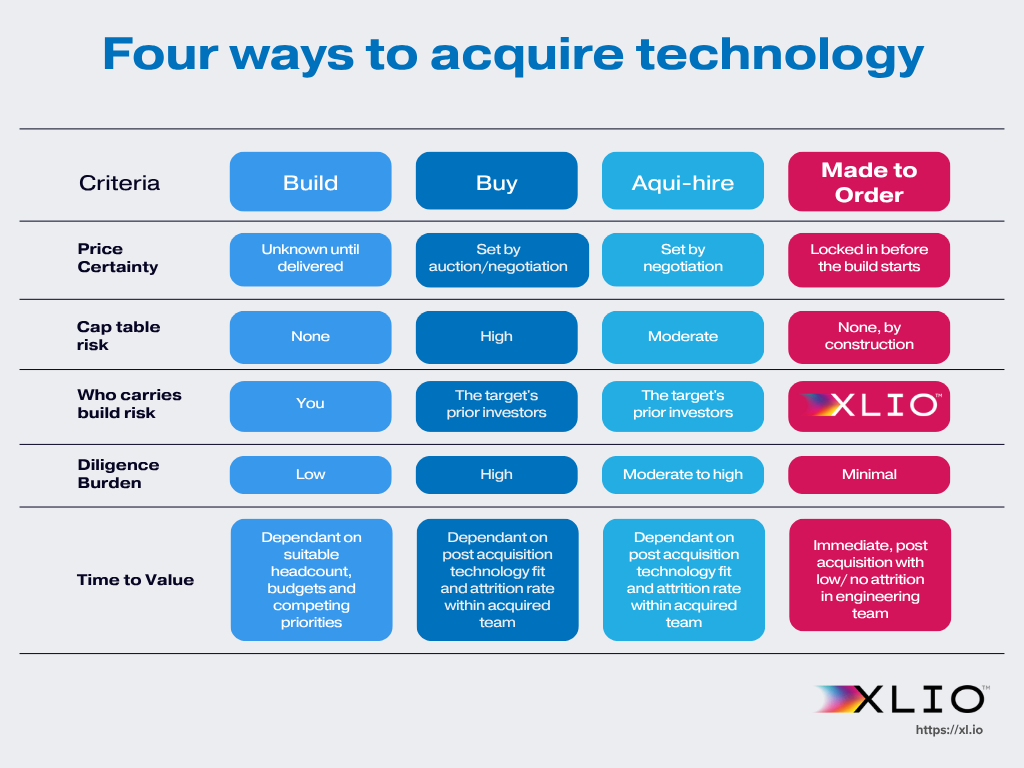
The comparison
Which one is right?
None of these four is right in every situation. Building in-house still makes sense when the capability is close to what you already do well. Buying an existing company still makes sense when the right target exists, the customer base and/or revenue are material to the deal and its cap table is clean. Acqui-hires still make sense when the team matters more than the product.
Made to Order makes sense when you know exactly what you need, when you need it, and you'd rather pay a locked price for a purpose-built result than gamble on finding one off the shelf, with “baggage” you’re prepared to deal with.
The failure-rate research above isn't a reason to avoid M&A. It's a reason to ask, before the next deal, which of these four paths you're choosing, and whether you've priced in the risks that come with it.
Why not get in touch and we'll help you assess whether Made to Order is right for you.
Sources: Harvard Business Review, Bain & Company, BCG, and a 40,000-deal analysis reported by Fortune and reviewed by the CFA Institute (2024) on M&A failure rates; cap table due diligence figures from FIH Group M&A advisory research.
Photo by Javier Allegue Barros on Unsplash